SaProtΔG and ESM3ΔG — structure-aware protein language models fine-tuned on 1.8 million stability measurements — predict absolute folding free energy (ΔG) with Spearman ρ = 0.88 and RMSE = 0.81 kcal/mol.
Predicting absolute protein folding stability is a long-standing challenge in biophysics, with broad applications in protein design and in understanding genetic variation and evolution. The challenge arises from the complexity and diversity of protein structures, as well as the difficulty of predicting a small difference between large thermodynamic driving forces favoring and opposing folding. Physics-based simulations have shown limited success at predicting stability and are often computationally intractable, and machine learning methods have been constrained by the lack of sufficiently large experimental datasets.
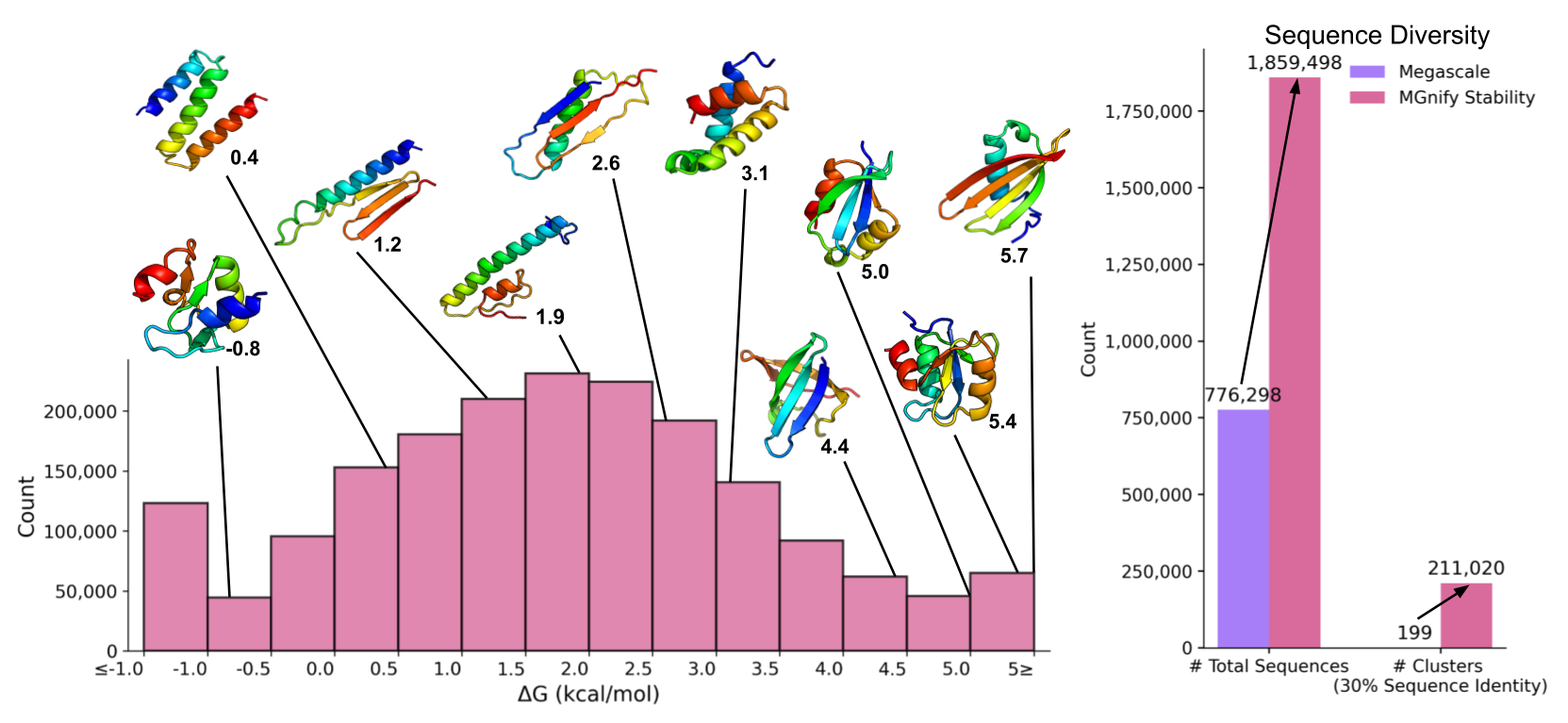
To overcome these challenges, we used cDNA display proteolysis to create the MGnify Stability Dataset, composed of over 1.8 million new experimental stability measurements on protein domains 60–80 amino acids in length. This diverse dataset includes 211,020 sequence clusters (at 30% identity) and 129,303 structural clusters (at TM-score 0.5). Using this dataset, we developed the predictive models SaProtΔG and ESM3ΔG, which accurately predict absolute folding stability for small domains with root mean squared error of 0.8 kcal/mol over a 6 kcal/mol range (Spearman rank correlation of 0.88).
These predictors show high accuracy at predicting effects of substitutions, insertions, and deletions, successfully identify global trends toward higher stability in thermophilic organisms, and improve discrimination of stable and unstable computationally designed proteins. Our results illustrate how mega-scale biophysical measurements can complement existing evolutionary and structural data to enable accurate absolute stability prediction for small domains.
Fig. 1 · Distribution of ΔG values and sequence diversity of the MGnify Stability dataset.
We fine-tuned two pre-trained structure-based protein language models — ESM3 and SaProt — by adding a per-residue stability regression head. Parameter-efficient fine-tuning with LoRA (rank-4) achieved the best performance among all approaches tested. Models are jointly trained on absolute stabilities (ΔG) and relative stability changes (ΔΔG) from mutations, using loss weights of 0.3 (ΔGWT), 0.3 (ΔGmut), and 1.0 (ΔΔG). Results reported are ensembles of three independent training runs.
Takes a raw PDB or CIF file and uses the ESM3 encoder to produce sequence, structure, and coordinate tokens simultaneously. LoRA adapters are applied to the layernorm_qkv and out_proj attention projections (rank-4).
A stability regression head (1536 → 1) aggregates per-residue embeddings into a global ΔG estimate, followed by a learnable sigmoid scaling into the training range (−1 to 5 kcal/mol). Achieves Spearman ρ = 0.87, RMSE = 0.82 kcal/mol on the MGnify Stability test set.
Converts structural information into SA tokens via Foldseek, producing a string that alternates amino-acid and backbone geometry letters (e.g., AaGgLl…). This compact encoding is fed directly to SaProt 650M's masked LM, which was pre-trained on both sequence and structure.
LoRA adapters (rank-4) target the query, key, value, and dense feed-forward projections. The stability head (1280 → 1) with sigmoid scaling achieves Spearman ρ = 0.88, RMSE = 0.81 kcal/mol on the MGnify Stability test set.
Load either model with a single function call to predict ΔG, scan mutations, or rank designed proteins.
Predict the folding free energy ΔG (kcal/mol) for any small protein domain given a PDB or CIF structure. Accurately calibrated over a 6 kcal/mol range (RMSE 0.81 kcal/mol).
Predict ΔΔG for point mutations, insertions, and deletions. AUC 0.94 for identifying stabilizing mutations; indel RMSE 0.79–0.81 kcal/mol — a 13-point improvement over Rosetta for indel classification.
ESM3ΔG-predicted ΔG correlates with optimal growth temperature (OGT) at 2.43 kcal/mol per 100 °C — 2–9× steeper than ESM-IF, ProteinMPNN, and AlphaFold2 pLDDT zero-shot scores.
Rank and filter de novo designed proteins and nanobodies by predicted stability. Outperforms AlphaFold2 pLDDT and ProteinMPNN cross-entropy (AUC 0.65 ± 0.02 vs 0.68 ± 0.02) at discriminating stable from unstable designs.
Each cell in the heatmap shows the predicted ΔΔG when the wild-type residue at that position is replaced with one of the 20 standard amino acids. Blue = stabilising · Red = destabilising.
Spearman rank correlation between predicted and experimental ΔG on the MGnify Stability test set of 3,283 sequences from 590 sequence clusters with limited sequence and structural similarity to training data (Fig. 2a).
Select a model and a protein, then click Run to simulate a prediction. Switch between ΔG prediction and mutational scan modes.
The source code and pre-trained model weights are publicly available at GitHub and Hugging Face, respectively. The full MGnify stability dataset, training dataset, benchmark dataset, and raw data processing scripts are deposited at Zenodo.
If you use SaProtΔG or ESM3ΔG in your research, please cite: